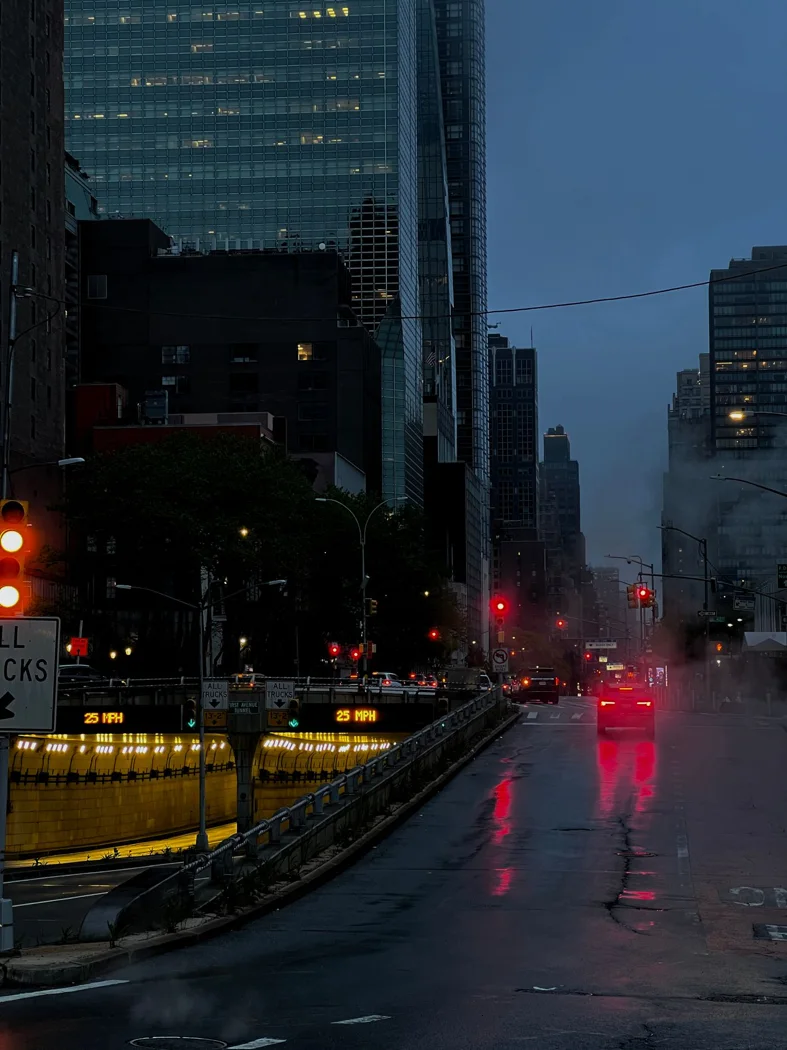
A location becomes part of a show's argument when it shapes the choices available to the people living there. A street can permit a chance encounter, separate neighbors or expose someone who would rather remain unseen. A coastline can offer a wide horizon while a community's social life remains tightly enclosed. The important question is not whether the scenery is memorable, but whether the story would change if its people occupied a differently organized place.
The city distributes knowledge
HBO describes The Wire through its attention to crime in Baltimore from civilian and law-enforcement perspectives. Even that basic division suggests a city whose inhabitants do not all see the same world. A place familiar to one group may be a destination, a workplace or an area of suspicion to another. The overlap produces drama without requiring anyone to possess a complete map of other people's lives.
Moving between perspectives changes the meaning of a street. An exterior that first appears to establish atmosphere can later register as a boundary between responsibilities. A journey that seems short on a map may involve substantial social risk. Geography therefore works with institutions and habits: where people are allowed to go matters alongside where they are physically able to go.
In this kind of city drama, the recurring route can become more revealing than the unusual landmark. Seeing who uses the same entrance, waits in the same place or avoids the same corner builds a picture of daily organization. The viewer gradually understands relationships between spaces, rather than merely accumulating attractive views of the city.
An open landscape can make privacy scarce
Broadchurch begins with a boy's body found on a Dorset beach and an investigation by Ellie Miller and Alec Hardy. The coastal premise combines an expansive public landscape with the more concentrated world of local relationships. A beach belongs to many people at once: residents, visitors, workers, children and investigators may approach it with incompatible expectations.
This makes the difference between visibility and knowledge particularly useful. A person can be seen crossing an open space without anyone knowing why. Familiarity with a neighbor can create confidence that is stronger than the evidence behind it. A picturesque setting does not guarantee a transparent community; it can make the gap between an outward impression and a private life more striking.
The coast also gives a story a boundary that does not resemble a wall. People can look outward while their obligations keep pulling them toward the same households and conversations. This is a reading of what the setting makes possible, rather than a claim that every coastal mystery uses identical characters or reaches the same moral conclusion.
Shared spaces carry different histories
Treme is set in New Orleans after Hurricane Katrina. That premise makes place inseparable from disruption and continuation. A neighborhood is not only its buildings at a particular moment. It also consists of the uses people remember, the routines they hope to restore and the competing expectations attached to rebuilding.
A performance space, a doorway or a local business can therefore carry several times at once. There is what the viewer sees now, what a resident recalls, and what someone believes it should become. Drama can arise from the distance among these versions without treating the location as a mute illustration of a historical event.
Music and conversation can help a television setting feel socially occupied. Sound suggests activity outside the frame and people who were present before the principal character arrived. A camera that pauses for this surrounding life makes a different argument from one that treats every background person as an obstacle on the protagonist's route.
Who gets to pass through?
A useful way to understand a show's geography is to notice entrances and departures. Does a character knock, walk straight in, wait outside or arrive through a service corridor? These actions place people within social arrangements. The same room can feel hospitable to one visitor and conditional to another, even when the furniture and lighting remain identical.
Transport also provides a kind of narrative grammar. A car can make a character self-contained, while a shared journey forces conversation. A walk allows accidental contact that a direct cut between interiors would avoid. These are possibilities created by form and setting; their significance depends on what the individual series does with them.
Attention to access helps avoid reducing a place to a personality. A city is not simply gritty, a village is not inherently close-knit, and a coastal town is not automatically secretive. Those descriptions can erase differences among its inhabitants. A more precise reading asks which people experience belonging, scrutiny, mobility or constraint, and how the series lets us see that uneven distribution.
A convincing television location has relationships that continue beyond a single scene. The next return to a familiar street can carry knowledge from an earlier visit. When those accumulated relationships shape the drama, place becomes a way of thinking about society: the story's argument is partly contained in who can meet, who can leave, and who must remain visible to everyone else.